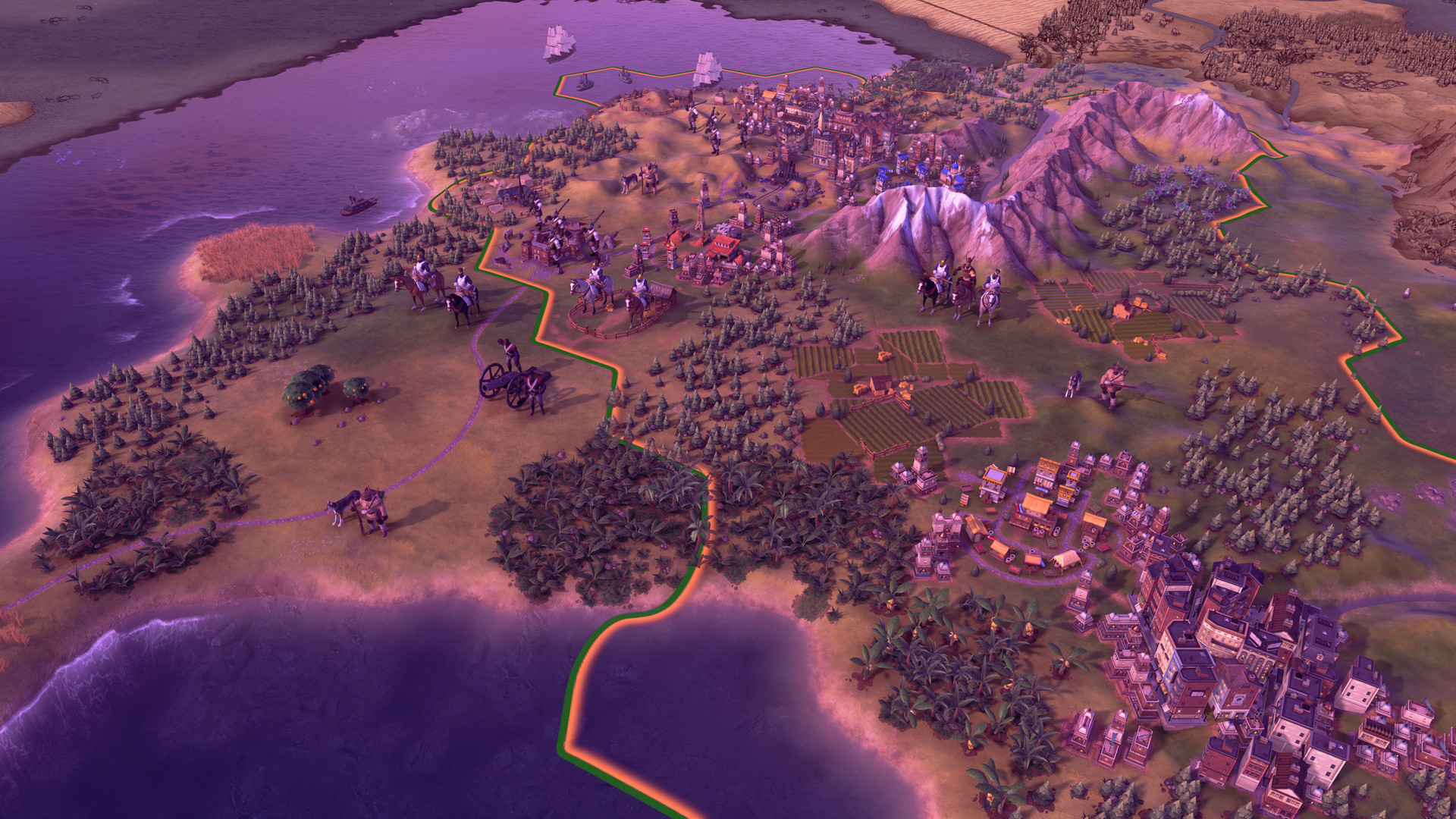
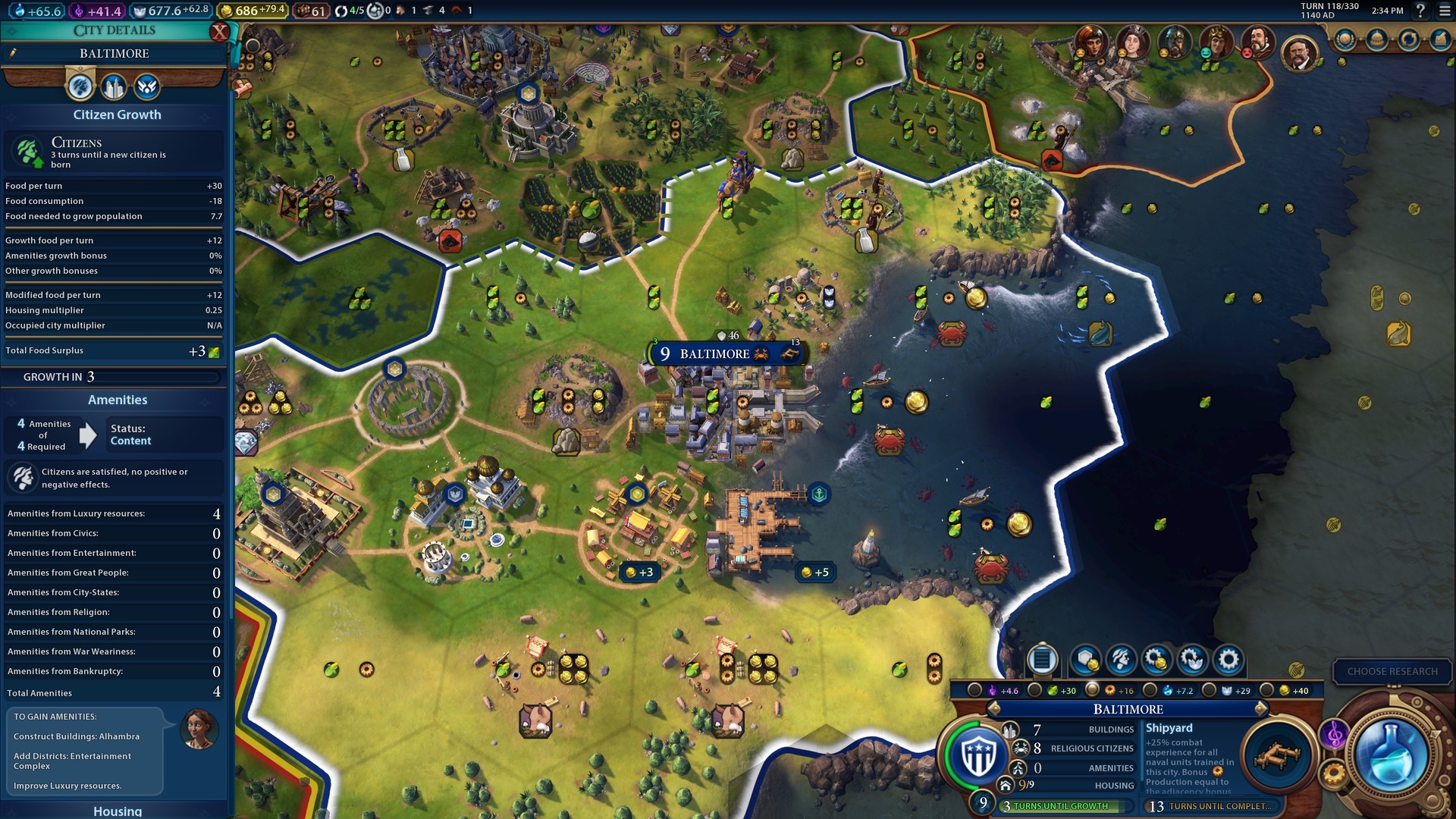
Civilization VI is the definitive entry in Firaxis' legendary 4X strategy franchise, with the Gathering Storm and Rise & Fall expansions creating the deepest and most complex Civ experience ever made. The district system forces meaningful city planning decisions, the policy card system allows flexible government adaptation, and the loyalty/era mechanics add narrative drama to empire management. Six distinct victory conditions ensure every game tells a different story. With both DLC expansions and the New Frontier Pass content, Civ VI offers near-infinite replayability across dozens of unique civilizations.
If you're just starting, check our beginner's guide first.
Essential Tips
1. Plan all district placements at city founding
Use the settler lens to preview adjacency bonuses before settling. A well-planned city is worth 3 poorly-planned ones.
2. Fresh water (rivers, lakes, coast) provides +3 Housing on city founding
Always settle on fresh water unless you have a very specific reason not to.
3. The Magnus governor's Provision promotion prevents a city from losing population when training settlers
Park Magnus in your highest-population city for settler spam.
4. Chopping forests and rainforests with the Magnus Groundbreaker promotion converts them to instant production
This speeds up wonders and districts enormously in the early game.
5. Trade routes to your own cities generate production and food
In the early game, domestic trade routes accelerate new city growth better than gold from international routes.
6. Beeline Apprenticeship (Medieval tech) for the +1 production on mines bonus
This single tech upgrade often doubles your empire's production output.
7. Three Campus districts with +3 adjacency each and buildings will carry your Science output through the entire game
Quality over quantity.
8. National Parks require 4 tiles of unimproved natural terrain with positive appeal in a vertical diamond shape
Plan these locations well in advance for Culture Victory.
9. The policy card Rationalism doubles Campus adjacency for cities with 10+ population
Combined with high-adjacency Campuses, this accelerates Science Victory dramatically.
10. Don't neglect military entirely when pursuing peaceful victories
A weak military invites AI aggression. Maintain enough units to deter attacks without diverting from your strategy.
Advanced Strategies
Build Optimization
The difference between an average build and an optimized one is massive. See our builds guide for full breakdowns.
-
Win by capturing every other civilization's original capital. Requires strong military production, strategic resource access, and the ability to maintain loyalty in conquered cities. Fastest with civilizations like Alexander (Macedon), Montezuma (Aztec), or Genghis Khan (Mongolia).
-
Core gear: Giant Death Robot, Modern Armor, Bombers, Nuclear Missiles
-
Stat priority: Production, Gold, Strategic Resources, Military Science
-
Win by completing the space race projects. The most reliable victory condition because it's hard to disrupt. Requires 3 Campus districts minimum, Spaceport, and sequential project completion. Korea, Babylon, and Australia are top Science picks.
-
Core gear: Campuses with high adjacency, Spaceport, Space Race projects
-
Stat priority: Science, Production (for projects), Gold
Mechanic Interactions
Understanding how Civilization VI's systems interact is where the real optimization lives. Our combat guide covers this in detail.
district placement + policy cards: Districts are specialized city zones (Campus for science, Holy Site for faith, Industrial Zone for production) built on specific tiles. Combined with policy cards, instead of a fixed government, you slot policy cards into a government type.
era score + loyalty system: Earning Historic Moments (founding religions, building wonders, winning battles) generates Era Score. When paired with loyalty system, cities have a loyalty meter influenced by nearby civilizations' population, amenities, governors, and era score.
world congress scaling: Gathering Storm's World Congress meets periodically for votes on global resolutions. Diplomatic Favor (earned through alliances and city-states) is used to vote. Resolutions can ban luxury resources, boost specific yields, or even trigger emergencies against civilizations that capture cities.
Equipment Efficiency
| Equipment | Best Use Case | Why |
|---|---|---|
| Giant Death Robot | Domination Victory (endgame) | The endgame melee unit with 130 combat strength, the highest in the game. |
| Nuclear Missile | Domination Victory (deterrent/offense) | Devastating area weapon that kills units, damages cities, and creates radioactive fallout. |
| Battleship | Domination Victory (naval) | A powerful naval unit with ranged bombardment capability. |
| Bomber | Domination Victory (city assault) | Air unit that deals massive damage to districts, improvements, and units. |
| Modern Armor | Domination Victory (ground assault) | The strongest conventional ground unit with 95 combat strength and high movement. |
Location Efficiency
Capital City (Turn 1+): Your first and most important city. Its position determines your early game trajectory. Settle on fresh water for +3 Housing. Nearby mountains, reefs, or rainforests provide adjacency bonuses for districts. Never lose your capital.
Industrial Zone (Medieval Era+): The production district, critical for all victory types. Adjacent mines, quarries, and aqueducts boost its yield. The Factory building provides +3 Production to all cities within 6 tiles. The most universally important district.
Campus District (Ancient Era+): Science-generating district essential for Science Victory and useful for all strategies. Mountains provide +1 adjacency each, rainforests +0.5 each. The Library, University, and Research Lab buildings add scaled Science output.
Theater Square (Ancient Era+): Culture and Tourism district for Culture Victory. Other districts and wonders provide adjacency. Great Work slots in its buildings generate Tourism. Paired with themed Great Works, a single Theater Square can generate massive Tourism.
Holy Site (Ancient Era+): Faith-generating district, essential for Religious Victory and useful for purchasing units and buildings with faith. Natural wonders and mountains provide adjacency. The Stonehenge wonder guarantees a Great Prophet for religion founding.
Mistakes Even Veterans Make
- Placing districts randomly without considering adjacency bonuses. A Campus with +0 adjacency is half as productive as one with +4. Plan before you build.
- Settling cities too close together (3 tiles apart). Cities need 4-6 tiles of workable terrain to be productive. Cramped cities compete for the same tiles.
- Building every district in every city. Specialize cities. Production cities get Industrial Zones, science cities get Campuses. Not every city needs everything.
- Neglecting Amenities. Negative amenities reduce yields by 15% and can cause city loyalty to plummet. Build Entertainment Complexes or use luxury resources to maintain +1 Amenities.
- Ignoring the World Congress in Gathering Storm. Diplomatic Favor is a resource. Ignoring it means other civilizations pass resolutions that hurt you while you can't respond.
Pro Quick Tips
- Plan all district placements at city founding. Use the settler lens to preview adjacency bonuses before settling. A well-planned city is worth 3 poorly-planned ones.
- Fresh water (rivers, lakes, coast) provides +3 Housing on city founding. Always settle on fresh water unless you have a very specific reason not to.
- The Magnus governor's Provision promotion prevents a city from losing population when training settlers. Park Magnus in your highest-population city for settler spam.
- Start with Science Victory, switch to Domination Victory when ready
- Invest in Giant Death Robot above everything else
- Clear areas in order: Capital City → Industrial Zone → Campus District → Theater Square → Holy Site. See our maps guide
- district placement + policy cards together are stronger than either alone
Similar Games
If you enjoy Civilization VI, check out these related guides:
- Sid Meier's Civilization V Tips & Tricks: strategy game with similar mechanics
- Mount & Blade II: Bannerlord Tips & Tricks: strategy game with similar mechanics
- RimWorld Tips & Tricks: strategy game with similar mechanics