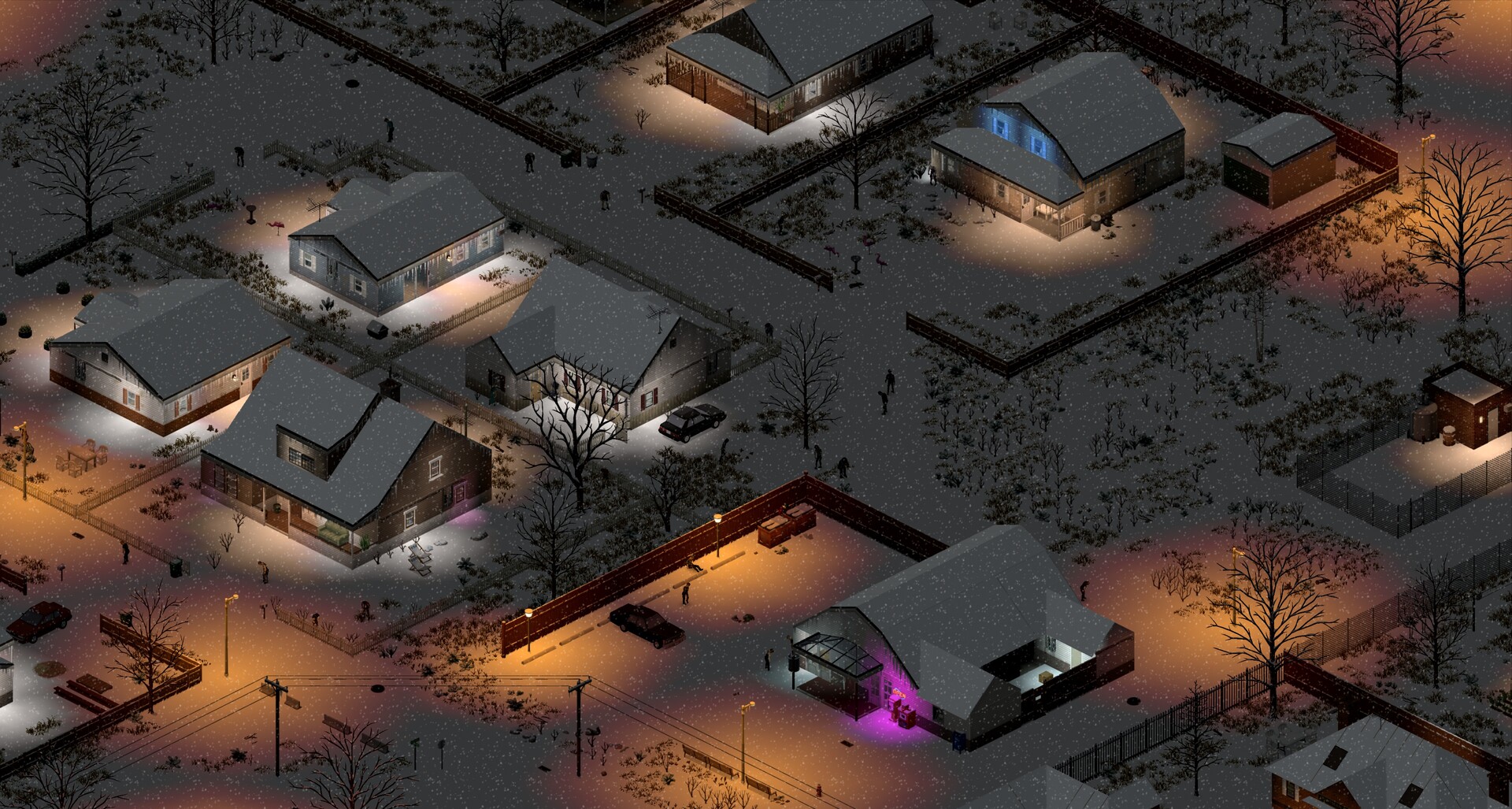


Project Zomboid is the most realistic zombie survival game ever made, simulating an entire county overrun by the undead with detailed systems for carpentry, farming, cooking, medicine, and the inevitable zombie infection. The game's tagline ('This is how you died') reflects its design philosophy: death is inevitable, but how long you survive is up to your skills and planning. The isometric perspective hides a staggeringly deep simulation where your character gets depressed, bored, sick, and eventually bitten. The multiplayer community has created massive persistent servers where hundreds of players build settlements and wage territorial conflicts. Build 42 (2025) added major crafting overhauls and the animal husbandry system.
If you're just starting, check our beginner's guide first.
Essential Tips
1. A bite is 100% fatal
A bite is 100% fatal. No exceptions, no cures. If you're bitten, use your remaining time (2-3 days) to stockpile supplies at your base for your next character.
2. Board up all windows on your base building on Day 1
Zombies are attracted to light and noise through unbarricaded windows. Sheet ropes provide access while keeping windows barricaded.
3. Sheet ropes (sheets + nails) attached to upper floor windows create alternate entry points
Enter from the second floor and destroy the stairs for a zombie-proof upper floor base.
4. Read skill books before training any skill
Skill books provide XP multipliers for the next few levels of that skill. A Carpentry book before building gives 3-12x XP bonus.
5. The water and power shut off around Day 30 (varies by server settings)
Build rain collectors and stock up on non-perishable food before this happens.
6. Zombies are attracted to noise in tiers: gunshots (massive radius), car alarms/house alarms (large), breaking windows (medium), walking (small)
Crouch-walk near groups to avoid detection.
7. Cars are the most powerful tool in the game
A working car lets you outrun any horde, carry massive loot loads, and establish bases far from zombie concentrations.
8. Tailoring skill lets you add protection patches to clothing
A leather jacket with reinforced patches provides significant scratch and bite protection. Level tailoring by ripping and patching clothes.
9. The key bind for 'push' (default: spacebar) saves your life constantly
Pushing a zombie down gives you time to escape or stomp them. Never fight without using push.
10. Louisville should only be attempted with a well-geared character and a reliable vehicle with a full gas tank
The zombie density makes walking through Louisville suicidal.
Advanced Strategies
Build Optimization
The difference between an average build and an optimized one is massive. See our builds guide for full breakdowns.
-
The strongest starting occupation with a permanent axe damage bonus and +1 Axe skill. Axes are the best weapons in the game, making Lumberjack the most combat-effective start. The strength bonus also helps with carrying capacity.
-
Core gear: Fire Axe, Lumberjack Shirt, Duffel Bag
-
Stat priority: Axe skill, Strength, Carpentry
-
Starts with +3 Carpentry, skipping the painful early leveling phase. Can build barricades and rain collectors immediately on Day 1. Weaker in combat than Lumberjack but faster at establishing a defensible base.
-
Core gear: Hammer, Nails, Planks, Saw
-
Stat priority: Carpentry (already high), Strength, Axe skill
Mechanic Interactions
Understanding how Project Zomboid's systems interact is where the real optimization lives. Our combat guide covers this in detail.
zombie infection system + carpentry barricading: Zombie bites are 100% fatal with no cure. Combined with carpentry barricading, carpentry is the most important skill, enabling barricaded windows, reinforced doors, walls, stairs, and entire structures.
foraging and farming + character traits: Farming requires finding seeds, tilling soil, watering plants, and waiting through growth cycles (7-14 days). When paired with character traits, character creation uses a positive/negative trait point system.
erosion over time scaling: The world degrades over months. Vegetation overgrows roads and buildings, water and power shut off after roughly 30 days, food in stores rots, and zombie population shifts. The apocalypse isn't static; it gets harder over time as infrastructure fails and natural foraging becomes the only food source.
Equipment Efficiency
| Equipment | Best Use Case | Why |
|---|---|---|
| Baseball Bat | Early game all builds | The most common early weapon, found in homes and sporting goods stores. |
| Axe | Lumberjack, all combat builds | The best melee weapon class in the game. |
| Shotgun | Emergency situations, car escape available | Devastating at close range with high damage and spread hitting multiple zombies. |
| Spear | Early game crafting builds | Craftable from sticks and knives/forks with the Spear crafting recipe. |
| Crowbar | All builds (utility + combat) | A durable melee weapon doubling as a tool for prying open locked containers and windows. |
Location Efficiency
Muldraugh (Beginner): The default starting town and the most beginner-friendly location. Small town with moderate zombie density and easy-to-find resources. The warehouse district provides building supplies. Gigamart supermarket is the major loot target.
West Point (Intermediate): A larger town with higher zombie density and better loot variety. The school provides skill books, the hardware store has tools, and the restaurant district has abundant food early on. More dangerous but more rewarding than Muldraugh.
Riverside (Intermediate): A riverside town with good fishing access and moderate zombie density. The gun store provides firearms and ammunition. The gated communities have defensible houses suitable for permanent bases.
Rosewood (Intermediate-Advanced): A small town with the fire station (fire axes, fire suits) and prison (excellent loot, extremely dangerous). The prison is one of the most rewarding but deadliest locations in the game.
Louisville (Advanced-Expert): The massive city in the northwest with the highest zombie density and best loot in the game. Louisville has everything (gun stores, military surplus, hospitals) but the zombie population is astronomical. Endgame destination.
Mistakes Even Veterans Make
- Fighting large groups of zombies. Even experienced players can be bitten during multi-zombie combat. Lure zombies away in small groups and fight 1-3 at a time.
- Not barricading on Day 1. An unbarricaded house attracts zombies to your position overnight. Waking up surrounded by zombies entering through windows is a common early death.
- Ignoring skill books. Training carpentry from level 0 without the XP multiplier book takes 10x longer. Always read the relevant book before grinding any skill.
- Using guns without a vehicle escape plan. Gunshots attract hundreds of zombies from a massive radius. Without a car running nearby, you'll be trapped and overwhelmed.
- Choosing only positive traits in character creation without understanding the drawbacks. Traits like Obese and Slow Reader have manageable downsides but give significant points for powerful positive traits.
Pro Quick Tips
- A bite is 100% fatal. No exceptions, no cures. If you're bitten, use your remaining time (2-3 days) to stockpile supplies at your base for your next character.
- Board up all windows on your base building on Day 1. Zombies are attracted to light and noise through unbarricaded windows. Sheet ropes provide access while keeping windows barricaded.
- Sheet ropes (sheets + nails) attached to upper floor windows create alternate entry points. Enter from the second floor and destroy the stairs for a zombie-proof upper floor base.
- Start with Carpenter, switch to Lumberjack when ready
- Invest in Baseball Bat above everything else
- Clear areas in order: Muldraugh → West Point → Riverside → Rosewood → Louisville. See our maps guide
- zombie infection system + carpentry barricading together are stronger than either alone
Similar Games
If you enjoy Project Zomboid, check out these related guides:
- Palworld Tips & Tricks: survival game with similar mechanics
- Rust Tips & Tricks: survival game with similar mechanics
- ARK: Survival Evolved Tips & Tricks: survival game with similar mechanics